140. NS Savannah
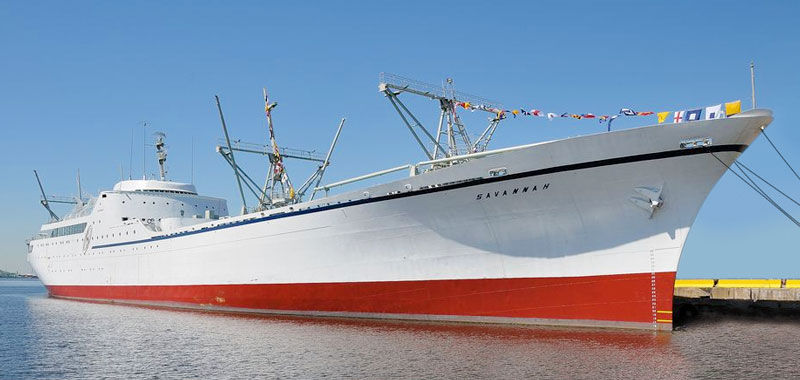
Our Navy’s submarines and aircraft carriers are all nuclear-powered. They have a small reactor that enables them to sail great distances without refueling—and without emitting air pollution by burning oil. Why can’t commercial cargo ships, which account for the vast majority of maritime traffic, be nuclear powered as well?
That was Eisenhower’s dream, anyway. In 1953, he delivered his Atoms for Peace speech at the UN, in which he argued that “the miraculous inventiveness of man” could be transformed from a scourge to a benefit for humanity. He wanted to take nuclear technology, which had been the province of the government and the military, and place it before the public.
It was, and is, a beautiful dream: abundant, cheap, clean energy powering everyday life. A cornerstone of Eisenhower’s initiative was the NS Savannah, our first nuclear-powered cargo and passenger ship. It was a showboat, with limited cargo space and sumptuous, space-age cabins, lounges, and bars, designed to sail the world less as a practical specimen than a demonstration of exciting possibility. The interiors were chic and smartly designed; the gleaming hull—never smudged with smoke—more like a yacht than a cargo ship.
She was never designed to be a money maker, although that’s why she was decommissioned in 1972. Oil was, and still is, just so cheap. But it has obvious drawbacks. Today, docked in Baltimore, the Savannah isn’t just a relic of atomic optimism; she still implicitly asks whether the atom can peacefully power a cleaner world.


Special thanks to Peter Wallace for suggesting the NS Savannah.
Links:
This post is part of The American 250, a series featuring 250 objects made by Americans, located in America, in honor of the country's 250th anniversary. 250 words on 250 works, from January 1 to December 31, 2026.
Too many emails? To receive a weekly recap instead, please subscribe on my Substack blog. Instructions for turning on the weekly summary can be found here.
Have something you’d like me to consider for inclusion? Please feel free to leave a comment!


