187. Brannock Device
In the old days in England (or possibly Wales), measurements were based on foodstuffs: four poppyseeds made a barleycorn, and three barleycorns made an inch. Thus for centuries, people estimated the inch—and its increments, the foot, yard, and mile—using a few seeds.[1]
This matters because our shoe sizes—still, today—are based on the barleycorn. The formula in the United States is 3 times the length of the foot in inches (i.e. the barleycorn length), less a constant: 22 for men, 21 for women. So a man’s size 9 foot is 31 barleycorns long, while a woman’s size 7 is 28 barleycorns. That’s 9.333… inches, a decimal that never resolves, much like finding a shoe that fits perfectly.
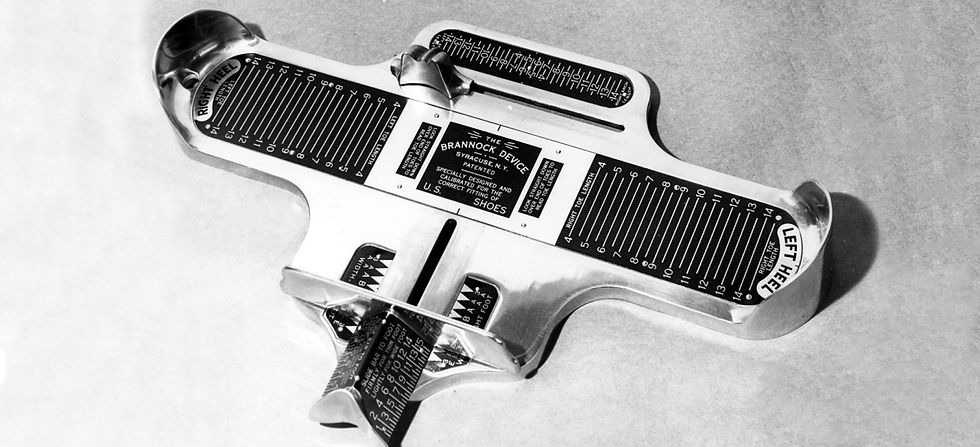
By the late 19th century, shoe sizes were standardized, with designated shapes for right and left feet. But only the foot’s length was measured. In the early 1920s, a college student named Charles Brannock working in his father’s shoe store in Syracuse realized he needed to measure both the foot’s width and the length of its arch (heel to ball), in addition to the overall length. Brannock experimented for two years, using his childhood Erector set to build an initial model that could capture all three measurements. He patented his namesake device in 1928. It hasn’t really changed since.
All of us have stood in a Brannock Device at some point, with a stranger kneeling at our feet, and yet very few of us know its name.


Hat tip to the podcast 99% Invisible, which recently featured the Brannock Device.
Links:
Chiefs give Brannock Devices their due – Benjamin Hill, Minor League Baseball, June 4, 2018
Tools of the Trade: How the Brannock Device helped the shoe industry put its best foot forward – Andrew Adam Newman, Retail Brew, January 18, 2023
Charles F. Brannock – The Lemelson Center for the Studio of Invention and Innovation, Smithsonian
This post is part of The American 250, a series featuring 250 objects made by Americans, located in America, in honor of the country's 250th anniversary. 250 words on 250 works, from January 1 to December 31, 2026.
Too many emails? To receive a weekly recap instead, please subscribe on my Substack blog. Instructions for turning on the weekly summary can be found here.
[1] Actually, the practice of using barley for measurement goes back to ancient times: 6 barleycorns equaled one finger, and 24 fingers (six fists of four fingers each) equaled a cubit. And as we all remember from Sunday/Saturday school, God specified that Noah’s ark be 300 cubits long, 50 cubits wide, and 30 cubits high. So the ark was 43,200 barleycorns long.


