191. Gee's Bend Quilts

During Martin Luther King Jr.’s funeral procession in Atlanta, the wagon bearing his casket was drawn by two mules from Gee’s Bend, Alabama. King had visited the isolated community twice during the civil rights struggle and admired the Benders, “who had lived simply and faced hard times.”[1]
Gee’s Bend sits in Wilcox County on a near-island within a bend of the Alabama River. There is only one road leading in. Its residents, many of whom were descended from the local plantation’s slaves, were poor—at times truly destitute, as in late 1932, when the widow of a creditor seized animals, tools, furniture, even jarred food. One woman later recalled how that day, her father sat on the ground and wept.
Many members of that older generation lived to see the first major exhibition of Gee’s Bend quilts in 2002. It was met with astonishment in the art world—here were handmade textiles with sophisticated abstract designs, made from scraps of cloth and worn-out work pants. The New York Times called them “some of the most miraculous works of modern art America has produced.” Co-curator Alvia Wardlaw said the exhibition was “a divine stroke of serendipity.”
One quilter, Arlonzia Pettway, remembered, “I had the happiest time I had in my life to see our quilts hanging on the wall, and peoples just praising our quilts, and everybody’s eyes full of water…white peoples was crying, and black peoples was crying, and everyone was crying…And I said, am I dead and in Heaven?”

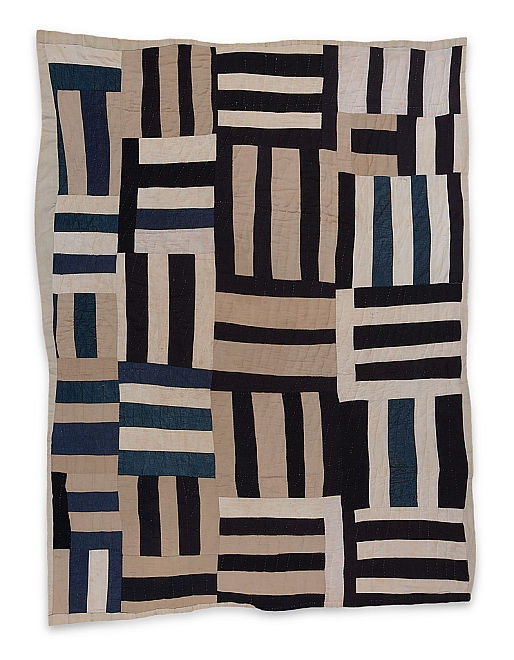


Special thanks to Alvia Wardlaw for her assistance. Most details come from the Gee's Bend Quilts exhibition catalog from 2002. All images are from the Souls Grown Deep Foundation.
Links:
Gee's Bend Quilters - Souls Grown Deep Foundation
An Interview with Alvia Wardlaw - Charles Henry Rowell, Callaloo Celebrating Texas Writers, Winter 2009 (via Jstor)
Who'd a Thought It: Improvisation in African-American Quiltmaking – Eli Leon, San Francisco Craft & Folk Art Museum (catalog for 1987 exhibition, via Internet Archive)
Gee's Bend Quilts: Culture-filled Designs From the Women of Gee’s Bend – Stephanie Moise, Etsy Journal (profiles of quilters with links to shop)
African American Quilts from the Cargo Collection - International Quilt Museum, Lincoln, NE (2015 exhibition)
This post is part of The American 250, a series featuring 250 objects made by Americans, located in America, in honor of the country's 250th anniversary. 250 words on 250 works, from January 1 to December 31, 2026.
Too many emails? To receive a weekly recap instead, please subscribe on my Substack blog. Instructions for turning on the weekly summary can be found here.
[1] Jeremy Jeffcoat, “Forgotten Freedom Fighters: Gee’s Bend, Alabama and the Voting Rights Movement of 1965,” AUM Historical Review, no. 6 (Winter 2017): 51.


