201. Glass Ballot Box

In 1856, San Francisco was a Gold Rush boomtown, awash in violence and corruption. An ad hoc, extralegal Committee of Vigilance formed, with thousands of armed civilians setting up sandbags around the entrance of their headquarters, a building christened Fort Gunnybags. They tried, convicted, and hanged four men. And they discovered a wooden ballot box with a false bottom and side that allowed officials to stuff fake ballots in without anyone noticing.
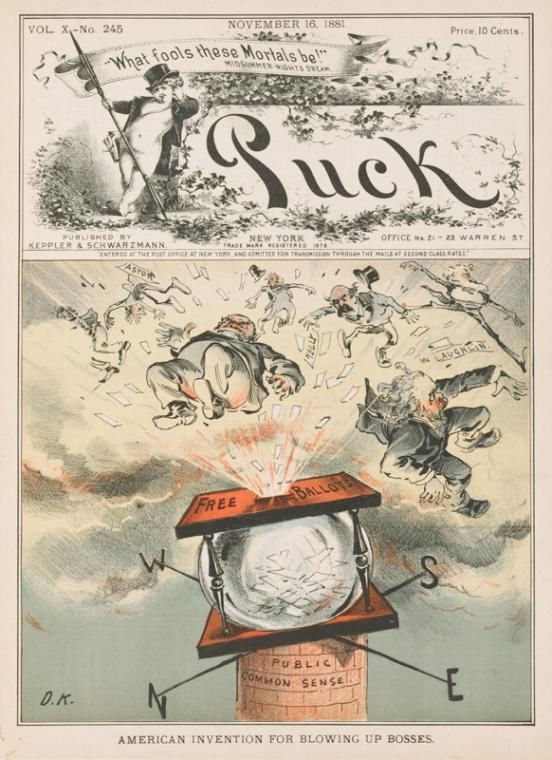
The crooked ballot box was national news, a huge outcry. In New York—which had its own problems with Tammany Hall—Samuel C. Jollie devised a solution: a glass globe floating in a cast-iron frame on four columns, half an hourglass, literal transparency in voting. If everything was in sight, there could, theoretically, be no way to rig an election. Every citizen could become a vigilante of democracy simply by paying attention.
The glass ballot boxes became a familiar symbol of elections in political cartoons for decades. They were commonly used until the 1890s, then disappeared, forgotten, in the early 20th century. Even if the contents of the globe were clearly visible, there was always skepticism about who was counting the ballots. There were also new concerns about anonymity—onlookers could see which party’s ticket you dropped in, and voters could be punished based on the color of their ballot. New counting machines and private voting booths replaced the old glass boxes—and introduced fresh waves of concern about how they could be rigged.


Links:
NEW-YORK CITY.; A Transparent Ballot-Box. – The New York Times, July 22, 1856
How to Solve Voter Fraud, 19th-Century Style – Mariana Zapata, Atlas Obscura, November 8, 2016
Voting and Electioneering, 1789-1899 – National Museum of American History, Smithsonian
Transparent: voting in America – Corning Museum of Glass exhibition, 2020
The Glass Ballot Box and Political Transparency - Ellery Foutch, Common Place, September 2016
Ballot Boxes in Many Shapes – William L. Clements Library, University of Michigan
This post is part of The American 250, a series featuring 250 objects made by Americans, located in America, in honor of the country's 250th anniversary. 250 words on 250 works, from January 1 to December 31, 2026.
Too many emails? To receive a weekly recap instead, please subscribe on my Substack blog. Instructions for turning on the weekly summary can be found here.


