121. Stereoscope
- Rainey Knudson
- Jun 27
- 2 min read
What is more important, more real: the image of the thing, or the thing itself?
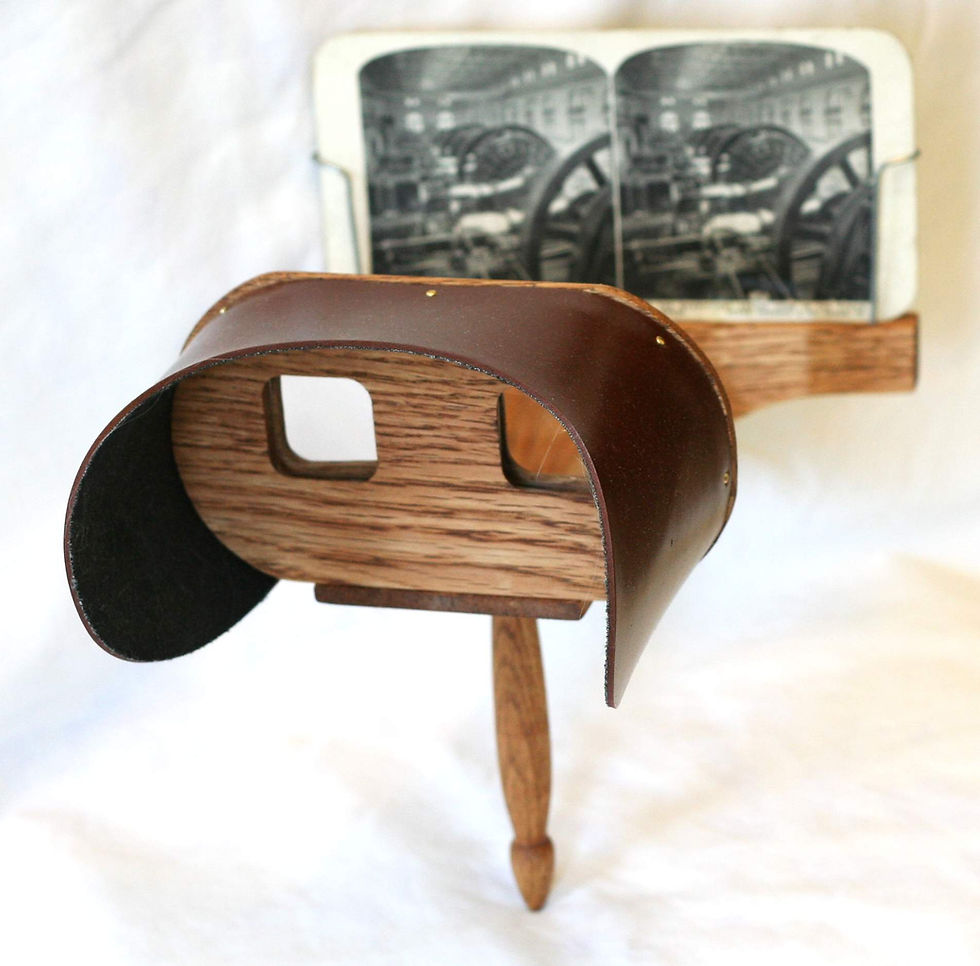
The stereoscope was the first immersive technology that tricked our brains into thinking we were there. The whole apparatus was designed to eliminate any reminders that we were looking at paper: it blocked peripheral vision, and the two slightly different photographs simulated the distance between our eyes so we could “see” three dimensions. Stones suddenly had volume; trees occupied depth of space; objects shifted against their background. Like reality.
The physician and poet Oliver Wendell Holmes made radical claims for the stereoscope, declaring, “form is henceforth divorced from matter,” and that a few negatives of “a thing worth seeing” is “all we want of it.” If we had a stereoscopic image of the Parthenon, what need did we have of the Parthenon itself?
Holmes’ inexpensive handheld stereoscope became wildly popular—50% of American homes had one by 1900. Suddenly, ancient monuments, great cities, our own spectacular western landscape—all were available, for pennies. Europe had the originals, which were costly and fixed. Americans had the cheap, transportable reproductions. We accumulated boxes of Rome, Jerusalem, Niagara, the pyramids. It was like we owned the world. Every screen since has been trying to close that gap between mechanical reproduction and the unique presence of the original in time and space.
Instead of a photograph saying, "this happened," the stereoscope said, "you are here." And we were. Almost.


Links:
Worth the effort: “The Stereoscope and The Stereograph” - Oliver Wendell Holmes, The Atlantic Monthly, June 1859
Stereographs Were the Original Virtual Reality – Clive Thompson, Smithsonian Magazine, October 2017
The Keystone View Company – The Stereoscopy Blog, June 2020
Stereographic New York: animated 3D images from the 1850s to the 1930s – Nick Van Mead, The Guardian, February 16, 2016
This post is part of The American 250, a series featuring 250 objects made by Americans, located in America, in honor of the country's 250th anniversary. 250 words on 250 works, from January 1 to December 31, 2026.
Too many emails? To receive a weekly recap instead, please subscribe on my Substack blog. Instructions for turning on the weekly summary can be found here.
Have something you’d like me to consider for inclusion? Please feel free to leave a comment!