130. Maurice Sendak, Where the Wild Things Are

After the wars, there was no going back to Dick and Jane. As a child, Maurice Sendak was terrified by the Lindbergh baby kidnapping—if a golden child of wealth and privilege could disappear, what did that mean for a poor kid from Brooklyn? “If that baby died, I had no chance,” he later said. Then, on the day of his bar mitzvah, his father received word that all of his extended family had been killed in the Holocaust.
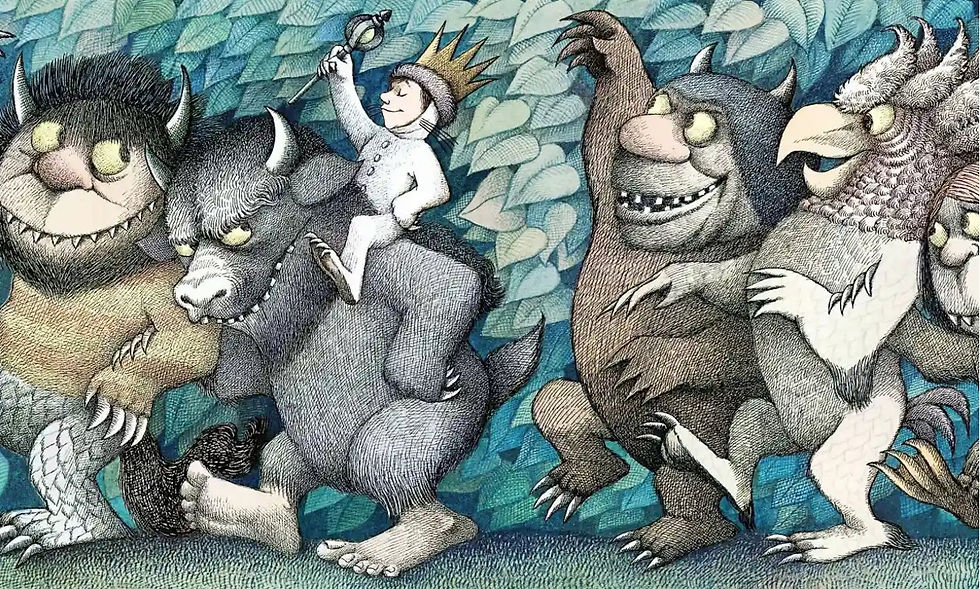
From this crucible of experience, it no longer made sense to encourage young readers to be well-behaved, neatly dressed and—most of all—devoid of fear and anger. In Sendak’s masterpiece Where the Wild Things Are, Max nails holes into the wall, chases his dog with a fork and yells at his mother. His punishment—being sent to bed without supper—unfolds into a fantastic epic: “That very night in Max’s room a forest grew.” Max travels to a distant land and becomes king of the monsters—modeled on his mother’s relatives, people who escaped the old country, who pinched his cheeks and told him they wanted to eat him up. Sendak and his siblings, with the unsparing cruelty of children, mocked these relations: “They were unkempt; their teeth were horrifying. Hair unraveling out of their noses.”
But the book ends tenderly. Max becomes homesick and returns from his imaginary land to his room, where he finds his supper waiting for him, still hot. The whole story occurs in 10 sentences.
Links:
Highly recommended: Touching interview with Sendak near the end of his life with Terri Gross on Fresh Air, September 20, 2011
The Children’s Authors Who Broke the Rules - Pamela Paul, The New York Times, September 16, 2011
9 Fascinating Facts About Maurice Sendak - Stacy Conradt, Mental Floss, June 9, 2023
This post is part of The American 250, a series featuring 250 objects made by Americans, located in America, in honor of the country's 250th anniversary. 250 words on 250 works, from January 1 to December 31, 2026.
Too many emails? To receive a weekly recap instead, please subscribe on my Substack blog. Instructions for turning on the weekly summary can be found here.
Have something you’d like me to consider for inclusion? Please feel free to leave a comment!


